Flipped Classroom
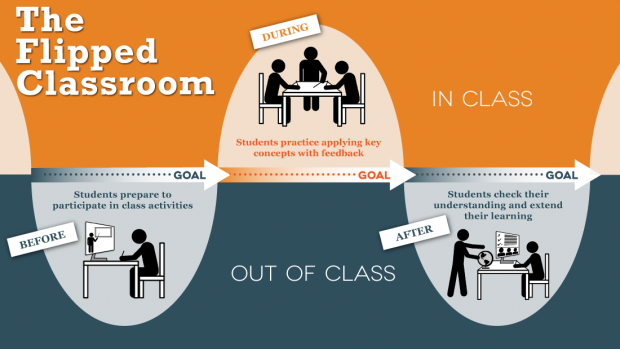
Flipped Classroom is a form of blended learning in which students learn new content online by watching video lectures, usually at home, and what used to be homework (assigned problems) is now done in class with teacher offering more personalized guidance and interaction with students, instead of lecturing. This is also known as backwards classroom, reverse instruction, flipping the classroom and reverse teaching.
Traditional vs flipped teaching
The traditional pattern of teaching has been to assign students to read textbooks and work on problem sets outside school, while listening to lectures and taking test in class.
“My AP Calculus class was a really anxious environment, it was weird trying to get through way too much material with not enough time. It was exactly the opposite of what I was looking for when I got into teaching.” (A teacher explaining what motivated her to adopt flipped teaching.)
In flip teaching, the students first study the topic by themselves, typically using video lessons prepared by the teacher or third parties such as Mathletics, the Khan Academy, and The University Edge. In class students apply the knowledge by solving problems and doing practical work. The teacher tutors the students when they become stuck, rather than imparting the initial lesson in person. Complementary techniques include[11] differentiated instruction and project-based learning.
Flipped classrooms free class time for hands-on work. Students learn by doing and asking questions. Students can also help each other, a process that benefits both the advanced and less advanced learners.
Flipping also changes the allocation of teacher time. Traditionally, the teacher engages with the students who ask questions — but those who don’t ask tend to need the most attention. “We refer to ‘silent failers,’ ” said one teacher, claiming that flipping allows her to target those who need the most help rather than the most confident. Flipping changes teachers from “sage on the stage” to “guide on the side”, allowing them to work with individuals or groups of students throughout the session.
History
As a concept, flip teaching is an extension of the ‘community of enquiry’ approach envisioned by John Dewey in the late nineteenth century. We see the essence of ‘flip teaching’ in core elements of Dewey’s pedagogic creed: “I believe that the child should be stimulated and controlled in his work through the life of the community. I believe that under existing conditions far too much of the stimulus and control proceeds from the teacher, because of neglect of the idea of the school as a form of social life […] The teacher is not in the school to impose certain ideas or to form certain habits in the child, but is there as a member of the community to select the influences which shall affect the child and to assist him in properly responding to these influences.”
Dewey’s ideas were embraced and adapted by numerous philosophers of pedagogy, notably Gregory Bateson and Jacques Rancière, and based on these influences, numerous approaches hinging upon the ‘teacher as facilitator’ concept emerged and enjoyed considerable popularity, especially in the nineteen sixties (eg. Problem-based learning).
Eric Mazur developed peer instruction in the 1990s. He found that computer-aided instruction allowed him to coach instead of lecture. Lage, Platt and Treglia published the paper “Inverting the Classroom: A Gateway to Creating an Inclusive Learning Environment” in 2000. In 1993, King published “From Sage on the Stage to Guide on the Side” in College Teaching, Vol. 41, No. 1 (Winter, 1993), pp. 30–35. Baker presented “The classroom flip: using web course management tools to become the guide by the side” at the 11th International Conference on College Teaching and Learning. Baker’s article presents the model of classroom flipping.
Starting in fall 2000, the University of Wisconsin-Madison used eTeach software to replace lectures in a computer science course with streaming video of the lecturer and coordinated slides. In 2011, two centers at Wisconsin Collaboratory for Enhanced Learning were built to focus on flipped and blended learning.
In 2004, Salman Khan began to record videos at the request of a younger cousin who felt that recorded lessons would let her skip parts she had mastered and replay parts that were troubling her. Khan’s model essentially provides one-to-one tutoring. Khan Academy videos are used as part of some educators’ flipped teaching strategy.
In the “The Classroom Flip” (2006), Tenneson and McGlasson presented an approach for teachers considering whether to flip their classrooms and how various approaches could enhance their teaching process, along. It also explores computer course management systems.
In 2007, Jeremy Strayer published his dissertation research conducted at The Ohio State University entitled “The effects of the classroom flip on the learning environment: a comparison of learning activity in a traditional classroom and a flip classroom that used an intelligent tutoring system.” This study highlighted the importance of attending to the ways the coordination of out-of-class and in-class activities can positively and negatively influence how students engage course tasks.
Clintondale High School
In 2011 Michigan’s Clintondale High School flipped every class. Principal Greg Green had been posting Youtube videos on baseball techniques for his son’s team. He then worked with social studies teacher, Andy Scheel, to run two classes with identical material and assignments, one flipped and one conventional. The flipped class had many students who had already failed the class — some multiple times. After 20 weeks flipped students were outperforming traditional students. No flipped student class scored lower than a C+. The previous semester 13 percent had failed. The traditional classroom showed no change.
Clintondale had been designated as among the state’s worst 5 percent. In 2010 more than half of ninth graders had failed science, and almost had half failed math. That year, the 9th grade flipped. The English failure rate dropped from 52 percent to 19 percent; in math, from 44 percent to 13 percent; in science, from 41 percent to 19 percent; and in social studies, from 28 percent to 9 percent. After 2011 the now-flipped school’s failure rate dropped from 30 to 10 percent. Graduation rates soared above 90 percent. College attendance went from 63 percent in 2010 to 80 percent in 2012. Results on standardized tests went up in 2012 and then dropped, although complicated by student body changes.
Teachers found that shorter videos (3–6 minutes) were the most effective. The school uses audio files, readings and videos from the Khan Academy, TED and other sources. Students favored the changes. Students unable to watch the videos at home watch the videos in school.
Notable schools
Usage of flipped teaching is not regularly implemented at the school wide level due to the level of difficulty of writing new classroom curriculum that does not employ the standard lecture/textbooks/board model. Nonetheless, there are schools actively engaged in developing curriculum and classroom techniques that take advantage of flipped teaching. Notable examples are:
- Quantum Campus in Berkeley and Mountain View are likely the strongest examples of what a flipped classroom can look like. They use advanced curriculum design methods from Duke University, UC Berkeley, and Stanford that focus on teaching students through highly engineered experiences without lecture or textbook. They have coupled these advanced teaching methods with flipped teaching methods that allow for students to have a powerful learning experience in the classroom and then follow that up with video and homework outside of the classroom.
- Rocketship Schools are working fast to develop a series of public charter schools that integrate a flipped teaching methodology right into the school experience itself. The schools are well funded and have purchased computers for students to use during the day learning digitally for up to 50% of the time. This allows for the school to take small groups of students and teach them in more impactful ways. Rocketship schools are dedicated to bringing these advanced methods to low-income neighborhoods.
- Acton Academy in Austin is a private school that uses the flipped classroom model because they believe that students should and can enjoy their experience in the classroom more than they do at other schools. Flipping the teaching allows for powerful social-emotional development of the students.
Notable teachers
Flipping is still in the early stages, with much experimentation about how to do it right. Its most important popularizers are not government officials or academic experts, but Aaron Sams and Jonathan Bergmann, a pair of high school chemistry teachers in Woodland Park, Colo., who wrote a book called “Flip Your Classroom: Reach Every Student in Every Class Every Day,” drawing almost completely on their own experience. It hasn’t been rigorously studied (most people cite only this one research paper.) Flipping’s track record in schools, while impressive, is anecdotal and short. But many people are holding it up as a potential model of how to use technology to humanize the classroom.
Math
In 2006, Maesumi taught a flipped Calculus I class at Lamar University. Students in the flipped class significantly outperformed the controls in Calculus II.
Stacey Roshan, a high school math teacher in Potomac, Maryland, reduced student anxiety through flexible testing and student created content. Her mother, also a math teacher, used the videos her daughter had created, as well.
In 2012, Crystal Kirch, a high school math teacher in Santa Ana, California, developed a “Watch, Summary, Question” (WSQ, pronounced “whisk”) assignment cycle, writing about it on her blog, her class website, and posting to her YouTube channel.
In 2012, Graham Johnson, a high school math teacher in Kelowna, British Columbia hosted the first-ever flipped learning conference in Canada.
Science
In 2007, Jonathan Bergmann and Aaron Sams, both high school science teachers at Woodland Park High School in Woodland Park, Colorado, implemented their own version of the flipped classroom by first moving all of their direct instruction to online videos, and then introducing the Flipped-Mastery model during the 2008-2009 school year, chronicled in their book “Flip Your Classroom, Reach Every Student in Every Class Every Day.
In 2012, Marc Seigel, a chemistry teacher at a public school in New Jersey presented at Flipped Learning Conference in Chicago his strategies, successes and failures in teaching, he also writes about on his blog.
In 2012, Carolyn Durley, a biology teacher in Kelowna, British Columbia, co-hosted Canadian Flipped Learning Conference.
In 2012, Richard Pierce and Jeremy Fox detailed their experiences in Pharmacy Education at Shenandoah University in Am J Pharm Educ. 2012 Dec 12;76(10):196. doi: 10.5688/ajpe7610196. Vodcasts and active-learning exercises in a “flipped classroom” model of a renal pharmacotherapy module.
Flipped classroom mastery
Traditionally, each topic in class receives a fixed amount of time for all students. Students who do not master the material get no extra time. Mastery learning upends this approach, by requiring each student to master the topic before moving to the next one. Flipped mastery learning applies the mastery concept to flipped classrooms.
Mastery learning was briefly popular in the 1920s, and was revived by Benjamin Bloom in 1968. It has shown dramatic success. The teacher provides materials, tools and support. Students set goals and manage their time.
Mastery rewards students for displaying competence. Students who initially turn in shoddy work must correct it before moving on. Before flipping, mastery learning was impractical in most schools. It was not possible to give different lectures for different groups of students. Testing was also impractical, because fast-learning students could reveal the test to those who followed.
In a flipped mastery classroom, students view each lecture and work on each exercise or project when they have mastered the precursors. As of 2013 only a few teachers had blended flipping and mastery.
Tim Kelly, winner of the Presidential Award for Mathematics and Science Teaching, adopted flipped mastery with his colleagues Corey Sullivan and Mike Brust. Sullivan estimated that 40 to 60 hours of work outside school for each of 12 units per course were required the first year. Another Presidential Award winner, Spencer Bean, converted after his daughter went through Kelly’s class.
Flipped mastery eliminates two other out-of-class routines: daily lesson planning and grading papers. The latter happens in class and in person. Replacing lectures with group and individual activities increases in-class activity. Every student has something to do throughout the class. In some classes, students choose how to demonstrate mastery – testing, writing, speaking, debating and even designing a related game. Moodle provides one way to manage the testing process. It creates a different test for each student from a pool of questions. Advocates claim that its efficiency allows most students to do a year’s work in much less time. Advanced students work on independent projects while slower learners get more personalized instruction. Some students might not get through the year’s material, but demonstrated competence on the parts they did complete.
Above passage courtesy: http://en.wikipedia.org/wiki/Flip_teaching
_____________________________________________________________________________________________
Awesome Links:
Great resource- http://ed.ted.com/on/HXvovdK8
More info– http://www.techsmith.com/education-flipped-classroom.html?gclid=CNHQxaqfmbsCFSHNOgodo3gAPg
Good graphics illustrating the idea: http://ctl.utexas.edu/teaching/flipping_a_class
Online Workshop- http://wileylearninginstitute.com/about/demo?gclid=CNjm-bifmbsCFbB9Ogod9SwA7g
Wikipedia articles- good stuff- seriously!-
 Valley Teams